

Tuesday, October 25, 2011
Raccoon
 Mammal. Mostly solitary, raccoons forage at night and sleep in their dens during the day. Their excellent night vision and hearing make them especially alert. Using sensitive, five-fingered forepaws, raccoons easily manipulate and open things. They are strong, though reluctant, swimmers and good climbers not afraid of dropping from a height of 12 meters (40 ft). Adults measure 46-66 cm (18-26 in) in length, plus a striped tail that's 23-35 cm (9-14 in) long. Females are usually smaller than males. When first born both their ears and eyes are closed, taking 18 to 24 days to open. After 4 to 6 weeks they can walk
Saturday, October 15, 2011
Polar Bear
 The polar bear (Ursus maritimus) is a bear native largely within the Arctic Circle encompassing the Arctic Ocean, its surrounding seas and surrounding land masses. It is the world's largest land carnivore and also the largest bear, together with the omnivorous Kodiak Bear, which is approximately the same size. An adult male weighs around 350–680 kg (770–1,500 lb), while an adult female is about half that size. Although it is closely related to the brown bear, it has evolved to occupy a narrower ecological niche, with many body characteristics adapted for cold temperatures, for moving across snow, ice, and open water, and for hunting the seals which make up most of its diet.Although most polar bears are born on land, they spend most of their time at sea. Their scientific name means "maritime bear", and derives from this fact. Polar bears can hunt their preferred food of seals from the edge of sea ice, often living off fat reserves when no sea ice is present.
Friday, October 14, 2011
Flying squirrel
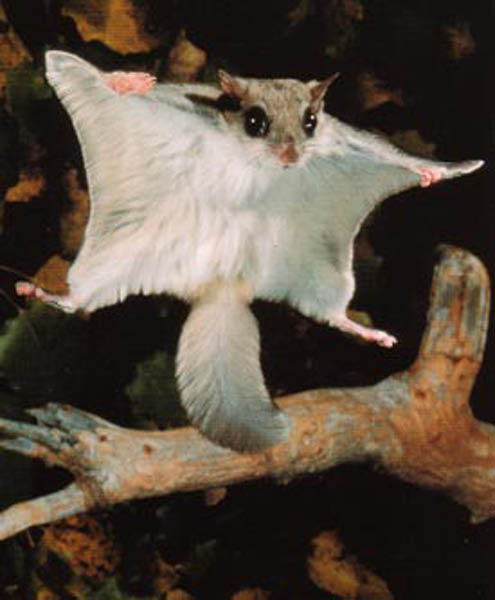
Flying squirrels are not capable of powered flight like birds or bats; instead, they glide between trees. They are capable of obtaining lift within the course of these flights, with flights recorded to 90 meters (295 ft).The direction and speed of the animal in midair is varied by changing the positions of its two arms and legs, largely controlled by small cartilaginous wrist bones. This changes the tautness of the patagium, a furry parachute-like membrane that stretches from wrist to ankle. It has a fluffy tail that stabilizes in flight. The tail acts as an adjunct airfoil, working as an air brake before landing on a tree trunk
Wednesday, October 5, 2011
Sea horse
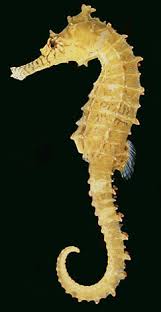
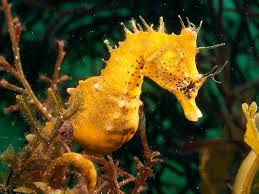
Have you seen a fish with a head looks like a horse? Ventral fins are used only very little for swimming.They are just shaken during swimming. Even though itis a bony fish it does not have corals in his body.Body lengths varies a range from 2.5cm to 30cm.They live in the sea.More than 32 species of sea horses are found distributed in the
oceans worldwide.They are very common in the stretch of the Pasific Ocean extending from North America to South America.
oceans worldwide.They are very common in the stretch of the Pasific Ocean extending from North America to South America.
Saturday, October 1, 2011
Weaver Bird
In the world of birds Weaver bird creates a much better mosaic nest than other birds.The size,Shape and the material used for building varies with the species of the weaver bird.Weaver bird has its origin in Africa,Asia and Australia.Male bird is colourful.


Mekong Cat Fish
The Mekong giant catfish is perhaps the most interesting and most threatened species in the Mekong river. For this reason conservationists have chosen it as a sort of “flagship” species to promote conservation on the Mekong. With recorded sizes of up to 10.5ft (3.2m) and 660lb (300kg), the Mekong’s giant catfish currently holds the Guinness Book of World Record’s position for the world’s largest freshwater fish.Although research projects are currently ongoing, relatively little is known about this species. Historically, the fish had a natural range that reached from the lower Mekong in Vietnam (above the tidally influenced brackish water of the river’s delta) all the way to the northern reaches of the river in the Yunnan province of China, spanning almost the entire 4,800 km length of the river. Due to threats, this species no longer inhabits the majority of its original habitat; it is now believed to only exist in small, isolated populations in the middle Mekong region. Fish congregate during the beginning of the rainy season and migrate upstream to spawn.They live primarily in the main channel of the river, where the water depth is over 10m while researchers, fishermen and officials have found this species in the Tonle Sap river and lake in Cambodia, a UNESCO Biosphere reserve. In the past, fishermen have reported the fish in a number of the Mekong’s tributaries; today, however, essentially no sightings are reported outside of the main Mekong river channel and the Tonle Sap region.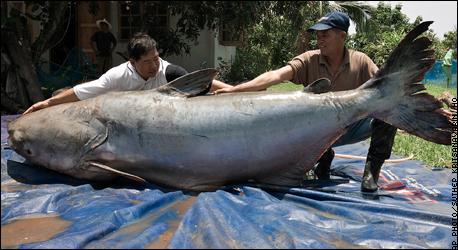

Planaria
They live in fresh water or brackish water .some species are terrestrial.The body size varies from 9mm to 12mm.
It is a free living flatworm.The body is bilaterally symmetrical.If this animal is cut lengthwise or breadthwise or along its axis,each part develops ins lost part and new animals are formed.This is called re-generation.
Planaria is a hermaphrodite because both male and female reproductive systems are present in the same animal.


It is a free living flatworm.The body is bilaterally symmetrical.If this animal is cut lengthwise or breadthwise or along its axis,each part develops ins lost part and new animals are formed.This is called re-generation.
Planaria is a hermaphrodite because both male and female reproductive systems are present in the same animal.
Subscribe to:
Posts (Atom)